



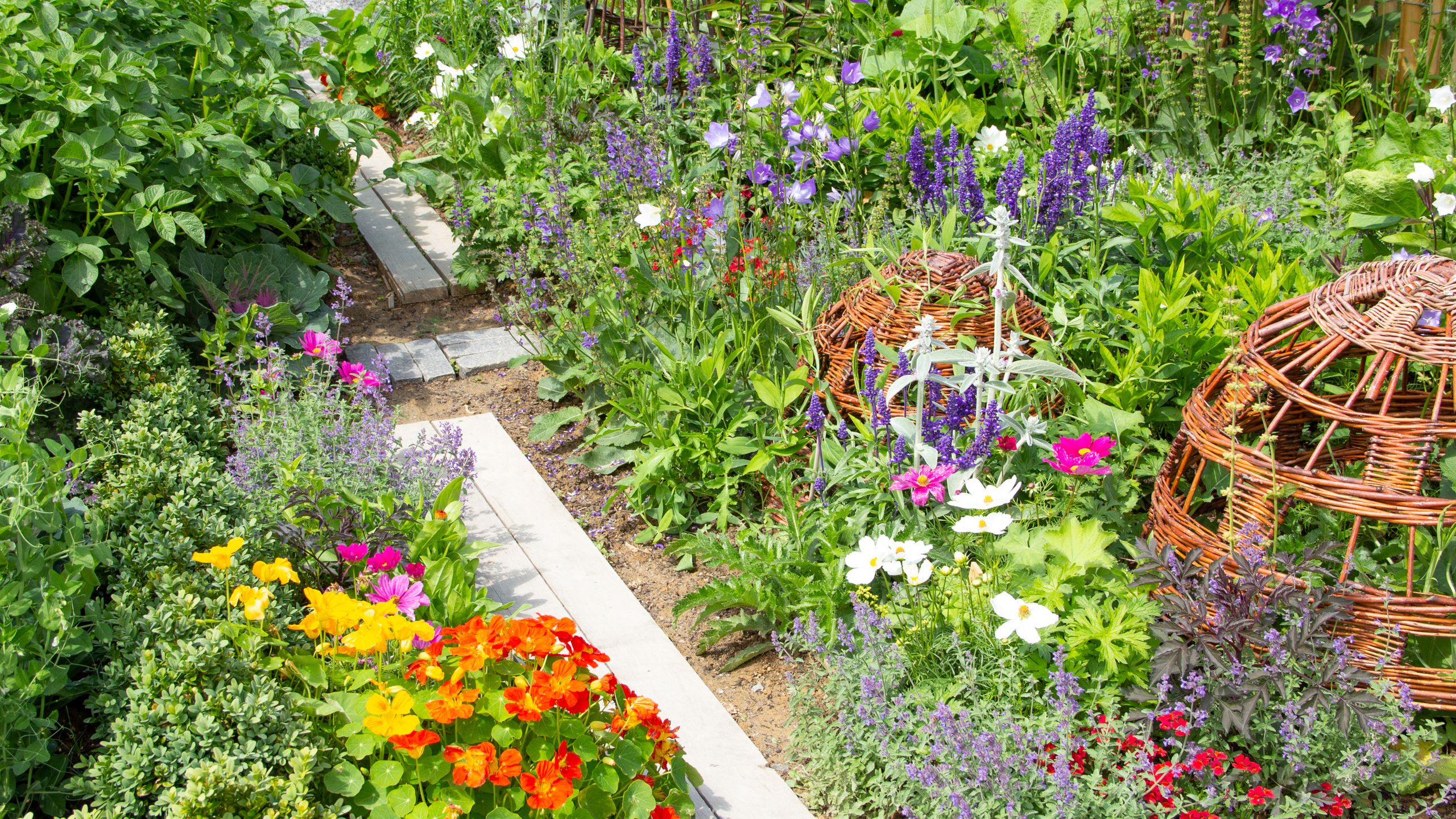
For years, edible gardens and ornamental borders were treated as entirely separate things. Vegetables belonged in neat rows in the kitchen garden, while flowers took pride of place in beds and borders. But increasingly, gardeners are beginning to realise that the two can happily coexist, so long as you pick the prettiest edible plants going.
Happily, this is no difficult task; in fact, some of the most beautiful plants you can grow are also edible. From jewel-bright stems to delicate flowers and attractive foliage, many fruits, herbs and even the very easiest vegetables earn their place in the garden long before they make it to the kitchen.
This approach has become increasingly popular in recent years. Rather than keeping fruit and vegetables confined to raised beds, gardeners are weaving them through borders, tucking them into pots and containers, and allowing edible plants to mingle with ornamentals in ways that feel natural and beautifully designed. (Just see The Lady Garden Foundation ‘Silent No More’ Garden at this year’s RHS Chelsea Flower Show, if you don’t believe us; they had parsnips in the mix!).


The prettiest edible plants to grow
‘Many edible plants are pretty enough to take centre stage in the garden and can be grown in containers and even hanging baskets,” ays Morris Hankinson, director of Hopes Grove Nurseries. ‘They add colour, texture and seasonal interest, as well as being edible is both fun, interesting and tasty.’
Morris recommends treating edible plants much like you would flowers. ‘Combine vegetables, herbs and flowers together, allowing colours, textures and shapes to work as they would in a natural planting scheme,’ he says.
So, whether you’re looking to maximise a small space, create a more productive garden, or simply add another layer of interest to your borders, look no further! These edible plants wholeheartedly prove that beauty and practicality can go hand in hand…
1. Rainbow chard
Rainbow chard is universally considered one of the prettiest edible plants to grow, and little wonder. With stems in vivid shades of pink, orange, yellow and red, it looks almost too pretty to eat.
‘Rainbow chard is one of the easiest ways to add edible colour into the garden,’ says Morris. ‘Its brightly coloured stems in shades of pink, orange, yellow and red look almost ornamental, especially planted amongst flowers. The young leaves can be mixed into salads and as the leaves mature, they can be cooked the same as spinach.’
Try weaving something like Crocus’s rainbow chard through cottage-style planting schemes, where its jewel-bright stems pop against softer flowers and grasses.
2. Nasturtiums
Nasturtiums are one of those wonderfully generous plants that seem to do it all. They flower prolifically, spill beautifully from containers and hanging baskets, and every single part of the plant is edible. One more time, for the people at the back? Every single part of the plant is edible.
‘Nasturtiums have trailing stems and bright orange, red or yellow flowers, which bring lovely bright colour to borders, containers or baskets,’ says Morris. ‘The leaves are peppery, the vibrant petals are edible, and they are perfect for filling spaces between plants.’
Their relaxed growth habit makes them ideal for softening the edges of raised beds or tumbling from pots, while the peppery leaves and flowers bring a burst of flavour to salads.
Shop nasturtiums below:
Crocus
Nasturtium – Tropaeolum Majus ‘tip Top Apricot’
Crocus
Nasturtium – Tropaeolum Minus ‘bloody Mary’
Crocus
Nasturtium – Tropaeolum Majus ‘black Velvet’ (tom Thumb Series)
3. Alpine strawberries
Tiny but mighty, alpine strawberries might just be one of the garden’s best-kept secrets. Their delicate white flowers, neat green foliage and jewel-like fruits make them a charming addition to beds and borders.
One professional gardener says he first fell for alpine strawberries after seeing them used at the RHS Chelsea Flower Show. ‘I’ve grown them in my own flower beds ever since,’ says Chris O’Donoghue, Director of Gardens Revived. ‘They create a beautiful living ground cover, and finding tiny strawberries hidden amongst other plants always feels like a little reward.’
Unlike larger strawberries, alpine varieties don’t send out vigorous runners, making them easier to weave into ornamental planting schemes. And, tucked beneath roses or between perennials, they add a playful little layer to the garden… one you can either leave as a treat for songbirds or nibble on yourself as you set to work on your borders.
No wonder people call them one of the best ground cover plants for a wildlife garden, eh? You can pick up a 9cm pot on Crocus.
4. Broad beans
Broad beans don’t immediately spring to mind when you think of ornamental plants, but the ‘Crimson-Flowered’ (available at Mr Fothergill’s) variety might just change that.
At RHS Chelsea Flower Show 2026, this striking variety drew admiring glances for its whorls of deep burgundy blooms weaving through roses and catmint. In fact, designer Frances Tophill reported that visitors kept asking, ‘What is that flower?’, only to be surprised that it was a broad bean.
As well as looking beautiful, broad beans help enrich the soil by fixing nitrogen, making them as hardworking as they are pretty. Plant them among ornamentals, and you’ll be rewarded with flowers first and a harvest later.
5. Garlic mustard
If you’re feeling adventurous, garlic mustard (available at Nature Seeds) offers a reminder that beauty can sometimes be hiding in plain sight.
Often dismissed as a weed, its dainty white flowers have recently appeared in Chelsea planting schemes, proving that the prettiest edible plants don’t always need to be cultivated to earn a place in the garden.
6. Purple kale and ornamental brassicas
Many gardens begin to lose momentum as summer fades, but purple vegetables like kale and ornamental brassicas come into their own later in the year.
‘Purple kale and other ornamental brassica plants bring structure for a long time after summer flowers fade,’ says Morris. ‘The ruffled leaves and deep colours add contrast to borders and make a striking winter display, plus they are packed with flavour and nutrients.’
Their rich purple tones look especially beautiful planted alongside silvery foliage or late-season grasses, bringing drama and structure to borders long after many flowers have finished. Have a go with the Broccoli ‘Claret’ F1 (purple sprouting) seeds from Crocus, or Thompson & Morgan’s Broccoli ‘Purple Rain’ F1 Hybrid (Purple Sprouting) seeds.
7. Herbs
Herbs may be hardworking kitchen staples, but many are heralded as being some of the prettiest edible plants around, too.
‘Flowers on rosemary, delicate flowers on chives, and soft silver foliage from sage make a border look beautifully designed while providing ingredients for the kitchen,’ promises Morris.
Personally, this writer loves growing flowering herbs; pollinators love it (especially my oregano ‘country cream’). Or this bumper kit of grow-your-own herb seeds from Amazon boasts mint, chives, parsley, thyme, and basil!
8. Calendula
Calendula, often known as pot marigold, earns its place in both ornamental and edible gardens. Its cheerful orange and yellow blooms flower for months on end, bringing a warm, sunny feel to borders and containers, and the ‘Candyman Orange’ variety from Thompson & Morgan will flower the longest.
The petals are edible and can be scattered over salads, baked into cakes, or even used to colour butter. Better still, calendula is loved by pollinators and readily self-seeds, creating that slightly wild, abundant look many gardeners crave.
It’s one of those rare plants that works hard while looking effortlessly beautiful. What could be better, eh?
9. Bronze fennel
If you love easy breezy and super natural-looking planting schemes, bronze fennel is hard to beat. Its feathery purple-bronze foliage brings movement and texture to borders, while its umbels of yellow flowers attract a host of beneficial insects.
Despite its ornamental appearance, every part of the plant is useful. The leaves have a delicate aniseed flavour, while the seeds can be harvested for cooking.
Planted among grasses and perennials, it looks every bit the designer plant, albeit with the bonus of being delicious, and you can pick up seeds easily from Thompson & Morgan.
FAQs
Which is the easiest vegetable to grow?
If you are looking for the very easiest vegetable to grow, look no further than herbs, salad leaves, and microgreens (like cress)! They can be grown on a windowsill easily enough, and keep you steadily supplied with tasty green goodies, asking very little in return.
What are the best vegetables to grow in a garden?
The best vegetables to grow at home include the speedy lettuce, the tasty tomato, the speedy radish, and pretty edible plants such as herbs or peas. Strawberries, too, are popular, but require netting and protection from greedy garden visitors.
Now you know the prettiest edible plants to grow, which will you be planting? Whatever you choose, it’s guaranteed to be a feast for the eyes and the tummies, so enjoy…
TOPICS
Read the full article here