


As temperatures are rising every summer, we might have to consider what we’re planting in our gardens. Varieties need to be drought-tolerant and potentially still offer us colour and texture.
‘By choosing and planting drought-tolerant species, we can conserve water, reduce maintenance efforts, and still enjoy a beautiful and thriving garden throughout the hot summer months,’ says gardening expert Sarah Raven.
Below, we look at five varieties that will get you started with expert tips from those who have drought-tolerant gardens.


1. Lavender
First up is lavender – a great, reliable option that bees and butterflies adore.
‘To suit its original climate of the Mediterranean, lavandula is both heat and drought tolerant. The flowers are edible and can be used to add delicious flavour to cocktails, syrups, sorbets, and salads. Simply cut back the flower spikes in the autumn, but do not cut into the woody stem,’ advises Sarah.
Julian Palphramand, head of plants at British Garden Centres, agrees, ‘You can’t really go wrong with lavender. Plant it somewhere sunny with decent drainage, and it’ll flower its heart out all summer while the bees do the rest of the work for you.’
For small gardens, check out the Munstead variety, currently £5.99 for one 2-3 litre pot at Gardening Express. It’s compact, fully hardy and very fragrant.
Amazon sells classic English lavender from Carbeth Plants for £11.99 for a 14cm pot; it’s great for beginner gardeners and perfect for pots.
2. Pelargonium or geranium
Not only are they lovely to look at, but they also have a really delicious scent and flavour and are the perfect addition to refreshing cordials and herbal tea, says Sarah.
‘Pelargoniums are not thirsty plants, but growth will become stunted if they are kept too dry. You should water and feed the plants well in the summer and deadhead to encourage a second flush of flowers,’ she adds.
Gardening Express have a lovely variety called Raspberry Ripple for £3.99 for a one-litre pot. It has pretty pink petals with raspberry speckles.
For a punchy red look at Amazon’s Bullseye Scarlet variety, £13.99 for a pack of six.
3. Achillea or yarrow
Sometimes called yarrow, this hardy plant is a great low-maintenance perennial that comes in a beautiful array of colours.
Gardening and greenhouse expert at Easy Garden Irrigation, Lucie Bradley, explains, ‘Remaining green and vibrant during hot, dry summers when many other plants would struggle, yarrow achieves this by having evolved its roots, foliage and structure so that it can thrive in nutrient-poor, dry soil in strong sunlight and drying winds. Its sturdy root system is formed from deep, fibrous roots and creeping rhizomes, so it can reach deep into the soil for moisture.’
Julian loves this one too, ‘This is another star for our potentially warmer client, Achillea boasts flat-topped flowers in yellow, pink or red. It’s one of those plants that genuinely seems to prefer being left to its own devices, so it can thrive with little water.’
Summer Berries is a beautiful variety to choose as it has a lovely range of colours to brighten up your borders, from £9.99, Suttons.
For a pure white, classical look, opt for Crocus’s achillea millefolium, from £8.99 for a 9cm pot.
4. Verbena
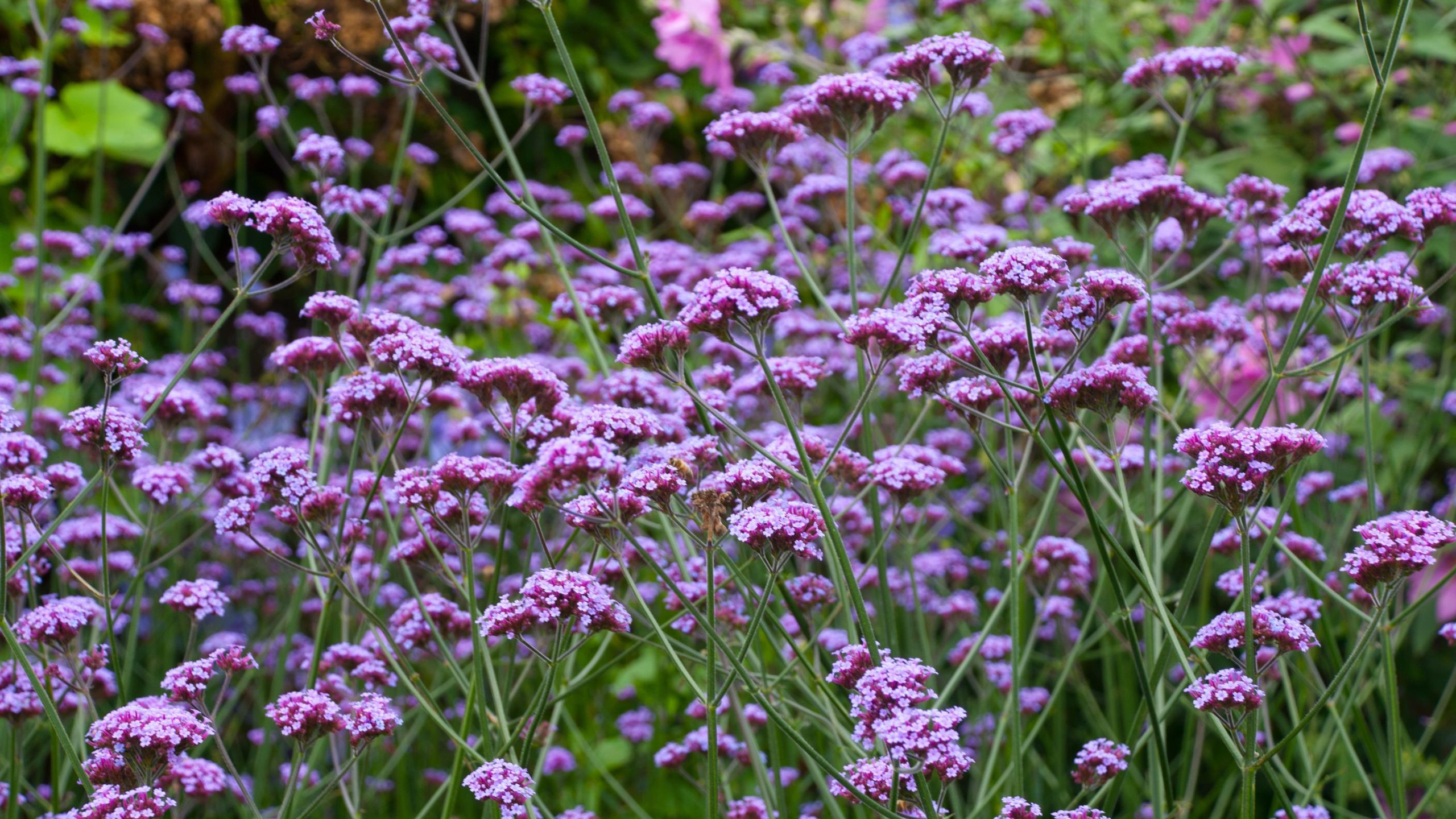
‘Verbena bonariensis produces an absolutely stunning display of purple flowers at head height from late summer through to autumn and is shrouded in a confetti of butterflies as soon as there is a glimpse of sunshine,’ says Sarah. ‘They are drought-tolerant perennials, so they need little maintenance, but you should protect them with a layer of leaf mould or compost mulch in autumn.’
Lucie also recommends this lovely variety, ‘Native to tropical and subtropical South America has meant this architectural perennial has evolved its roots, stems and leaves so that it positively thrives in hot temperatures and minimal moisture, so that it actually grows faster and produces prolific blooms as temperatures increase.’
If you fancy giving this a go in your garden, we like J.Parker’s pack of five for £7.99. Great for pots and also as cut flowers, butterflies will be your best friend!
For a darker purple, consider the Santos Purple variety from Gardening Express, from £3.99.
5. Sea Holly or eryngium
For those who love more of an architectural look and perhaps less colour, sea holly is your go-to plant.
Sea Holly actually thrives under extreme temperatures, able to survive for months with just limited rainfall whilst requiring very little care.
‘Its supreme hardiness is a result of being native to dry, rocky and coastal regions of the world in which it adapted to cope in these extreme environments,’ explains Lucie. ‘Its ability to thrive in bright sunlight, high temperatures and low rainfall is primarily due to the long taproots which reach deep into the ground to access moisture, whilst at the same time it has evolved stiff, prickly leaves with a thick, waxy coating which means it loses very little moisture, even in hot, dry winds.’
The more traditional-looking sea holly can be bought from B&Q – they have the Blue Hobbit variety for £13.49 for three plants. For a silvery look that might suit a coastal-style garden, look at Crocus’s Magical White Lagoon, currently £7.50 for a 9cm pot.
Drought-tolerant garden essentials
Whitefurze Water Butt and Kit, 230L
This watering butt comes complete with the kit and a three-piece interlocking stand. It’s ideal for small to medium-sized gardens and will help you to keep a drought-tolerant garden watered.
5-in-1 Soil Moisture/Fertility/PH/Temperature/Sunlight Intensity Meter
This really is a handy bit of kit so you can measure moisture, pH, temperature, fertility and sunlight intensity in one go so you can ensure your drought-friendly plants get the best care.
RocketGro Organic Magic Mulch, 50L
It’s important to give your drought-happy plants a really good mulch to help keep the moisture in. This is a really good make with good reviews.
With the climate changing, it’s a good time to look at what plants will do well in the heat and are drought-tolerant. And choosing these resilient plants proves that creating a drought-tolerant garden doesn’t mean compromising on colour or character.
TOPICS
Read the full article here