




The Philips Baristina coffee machine was launched in the UK earlier this year to much fanfare, with a sleek design and an affordable price point for a bean-to-cup machine, it has an alot going for it. However, its biggest selling point (alongside it’s looks) is that it is unbelievably easy to use and is one of the best bean-to-cup coffee machines you can buy to ease the transition from a pod coffee machine.
In a nutshell
Philips has kept things very simple; like many coffee pod machines, it only has two options when making coffee: an espresso or a lungo. The machine makes the switch from pods to using coffee beans effortless. It does away with the mess and guesswork of other bean-to-cup machines doing the grinding, dosing, tamping and pulling the shot for you. All you have to do is touch one button, and every time you’ll get a consistently good cup of coffee.
It was so quick and easy to use the Philips Baristina coffee machine that it finally persuaded my Mum (a decades-long Nespresso owner) to switch out her pod coffee machine.
Product specs
Philips
Philips Baristina Automatic Bean to Cup Coffee Machine, White
- Coffee machine type: Bean-to-cup
- Dimensions: 18 cm (width), 34.5 cm (height), 38 cm (depth)
- Coffee options: Espresso and Lungo
- Water tank capacity: 1.2L
- Pressure: 16 Bar
- Weight: 5 kg
- Colourways: Black or White
- RRP: £299.99
Unboxing
What is immediately striking about the Philips Baristina is how much smaller it is than your average bean-to-cup coffee machine. It arrived in a compact cardboard box that was easy for one person to lift and carry.
The box immediately won me over, as once I removed the cardboard sleeve, the inside box side fell open to reveal the coffee machine. No awkward tugging or shuffling to tip the coffee machine out of its box. Only a small piece of foam was used inside the box to protect the coffee machine; all the packaging was recyclable cardboard.
The coffee machine is relatively straightforward to use. While it did come with an instruction book, a quick start guide was written out on the top of the box along with a QR code to a dedicated website that included a digital user’s manual.
The Baristina only comes with a white-handled portafilter, but other than a bag of beans, that is all you need to get brewing your first cup of coffee. However, if you do prefer a latte, you can buy the Baristina in a bundle with a milk frother for an RRP of £379 on Amazon.
First impressions
This is one of the best-looking coffee machines I’ve tested, I was testing the white version, but it is also available in black. I loved the chic matte white finish and the stylish fluted design. My one disappointment is that the coloured-handle porta filters, which this coffee machine launched with in the US, are currently not available in the UK. Here’s hoping they’ll land soon for an even more striking look on a kitchen worktop.
The coffee machine fits comfortably under a set of kitchen cupboards, and has a small foot print for a bean-to-cup coffee machine.
The water tank sits hidden at the back, and while relatively easy to lift out and refill, the tank felt more flimsy than my other coffee machines. The lid was completely removable rather than a simple flip-up, and a little tricky to lift off if you just wanted to fill it up with a jug. However, the water tank is a good size, I found it only needed refilling every five coffees.
I was a little concerned about the size of the drip tray; it doesn’t cover the whole bottom of the machine. Instead, it is a tiny box that can be easily removed to fit large mugs underneath. When making a couple of espressos in a row, the mess from drips on the bottom of the machine had me wishing for a larger drip tray.
Before using the coffee machine, you need to wash the portafilter and run a rinse cycle, which is easily done by slotting in the portafilter, filling the water tank and pressing the intensity boost button to run the cycle. The machine communicates via easy-to-understand blinking lights around three buttons (espresso, lungo and boost). When the intensity boost button stopped blinking, the machine was ready to go.
The machine doesn’t have a water filter, so there is the potential for hard water to impact the machine in the long-term. If you do live in a hard water area, as I do in London, you might want to only fill the water tank with filtered water; the machine will also alert you when it needs descaling.
There is nothing else you have to do to set up the coffee machine; the bean grind is automatically set. You can’t adjust it, but I found it to be spot on for the beans I was using. The Baristina is the definition of a plug-and-play coffee machine; you can be up and running in minutes.
What is it like to use?
The Baristina, for all its simplicity, is very fun to use, and became my party piece when testing it out at home. It is a fully automated system, so all you have to do is slide the portafilter into the machine until it clicks and place your coffee cup under the spout. Press your chosen coffee size button, then slide the portafilter over to the right and leave the machine to do the rest.
On the right-hand side, the portafilter will fill with coffee grounds, a job it does while waiting for the machine to heat up. This is where my guests would panic that the cup was on the wrong side to catch the espresso shot, but the portafilter will automatically move back over to the left, where it brews and pulls the perfect espresso (or lungo) into your cup.
Then you have to wait until the button stops flashing on top before removing the portafilter. There is alot of flashing and blinking buttons involved with this machine, but they were helpful prompts to follow.
The portafilter has a little button that ejects the puck, which I was a big fan of it. It means there’s no banging on the side of the bin, just press the button a couple of times.
What might put some people off is that the coffee machine has only two coffee options, espresso and lungo. I found myself using the espresso function most of the time as it was best suited to a latte base (I heated the milk using my Dualit milk frother). However, my partner and Mum, who both drink daily black coffees, loved the lungo function.
There is a degree of customisability with the machine; you can increase the intensity of the espresso or lungo by pressing the boost button after selecting your drink. You can also adjust the drink volume. You do this manually the first time, pressing your chosen size button for 5 seconds before moving the portafilter over to the right, and then pressing it again when it is dispensing the coffee into your cup. The machine will then save your chosen preference.
Personally, I found that the settings of the coffee machine were already set for the perfect espresso and lungo, so I didn’t use either of these adjustments beyond initially testing them out.
The ‘Morning Rush’ test
All the coffee machines we review are put through the ‘Morning Rush’ test, which usually involves going from turning the machine on to having two milky coffees ready. As the Baristina is best suited to espresso or americano drinkers (maybe with a splash of milk), this is what I timed it for, and it aced the test.
It achieved the task in under five minutes. The machine heats up within a minute or two, and it can grind the beans of your first coffee while heating up. Once it’s warmed up, it can produce either an espresso or a lungo from grinding to brewing in under 60 seconds. I put it to the ultimate test and cranked out five coffees (a mix of lungo and espresso) for some friends, and it achieved the task in 6 minutes.
If you are a latte drinker, the slowest part of the coffee machine process with the Baristina will be waiting for the milk frother to heat up. I didn’t try the Philips Baristina milk frother. However, using my own separate milk frother, I found I could still get two lattes out the door in around 8 minutes, because I could froth the milk while the coffee machine was brewing the espresso shot – something many budget bean-to-cup coffee machines can’t do.
Noise test
This coffee machine is relatively quiet. The specifications say its noise level is 72 dB, which is about the same level as a dishwasher, a little louder than a normal conversation. When I tested, I found the sound level to range to reach 78.9 dB at its loudest, which is when it’s grinding the beans. The brewing and dispensing of the shot were all much quieter.
Coffee quality
Kiss the Hippo is one of my favourite coffee shops in London, and my main reason for using their house beans in testing is so I can compare my finished result to their professional barista-made drinks. I’m happy to report that the Baristina measured up well.
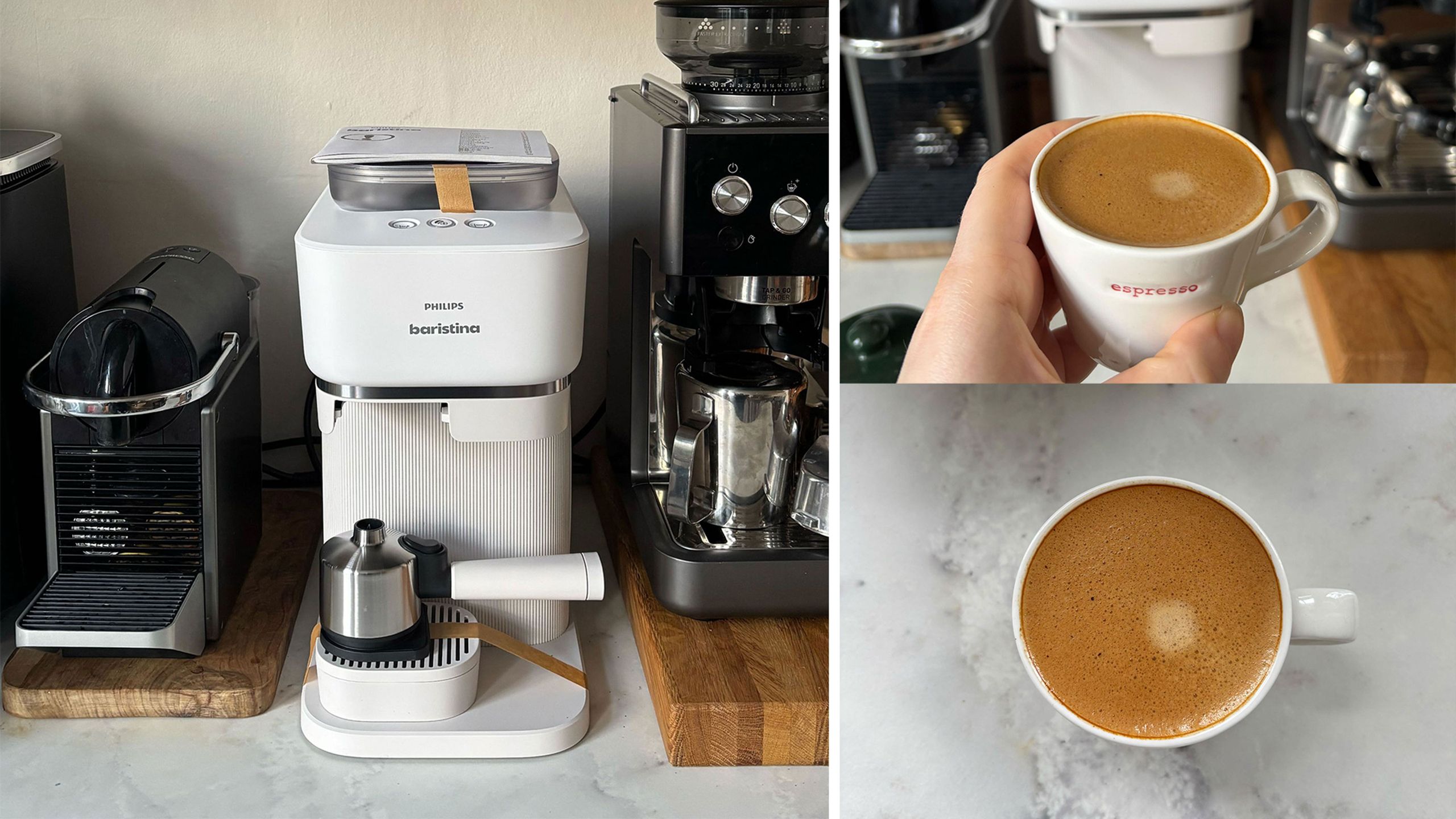
The espresso shots and lungos had a lovely, thick golden crema on top that lasted for a long time. The taste was lovely and smooth, with nice chocolately notes and a slight acidity. Overall, I was incredibly impressed by the quality of the espresso; the automated elements were calibrated perfectly. It delivered a superior coffee than I’d ever managed to achieve with my manual (and more expensive) bean-to-cup coffee machine.
Thermal stability
To test the thermal stability to see if the coffee machine was potentially overheating or over extracting I made 5 espressos in a row to compare the temperature from the 1st to the 5th cup. The 5th cup was slightly hotter than the 1st cup, indicating it could be at risk of overheating with extended use.
However, each of the five cups was consistently good, with a lovely flavour and beautiful crema. This machine is designed for easy consistency, which is excels at. The only issues I ever had with consistency was when I accidentally didn’t put enough coffee beans in the bean hopper and was left with a very soggy coffee puck to remove.
Cleaning
A white coffee machine sounds like it’s going to be a nightmare to clean; however, the simplicity of the grinding and brewing process and the lovely matte finish of the machine meant it was relatively easy to keep clean.
However, a word of warning, if the sight of coffee drips bugs you, then you do need to wipe it down after every use, every splash will show up.
All the parts, including the drip tray and water tank, are easy to remove and clean. The bean hopper isn’t removable, but the instructions recommend simply wiping it down with a damp cloth and leaving the grinder alone altogether. The only issue I could foresee with this is if you were to use dark roast beans, which can clog some grinders up with their oils
The portafilter was easy to clean; you just need to make sure to press the puck release button a couple of times when running it under water to remove all the coffee grounds.
Descaling the machine was fine, once I got the hang of all the button-holding times. The machine will alert you when it needs to be descaled by the espresso and lungo buttons blinking simultaneously after brewing a drink. Philips recommends using their own CA6700 liquid, which you can buy for £8 on Amazon, for descaling, which you add to the water tank.
To start the cycle, you need to insert the portafilter and press and hold the espresso and lungo buttons for 5 seconds. The descaling cycle will begin when the buttons change so that the espresso button stops blinking and the lungo starts blinking. You can remove the water tank, rinse, refill and put it back to start the flushing cycle. The whole process took around 15 to 30 minutes. Personally, I’d have preferred a dedicated button, as I found all the buttons and light blinking combinations more confusing than they needed to be.
The rinse cycle, which should be done at the start before using the machine, or if the machine hasn’t been used for a while, is quicker. You just need to press the intensity boost button for 5 seconds with the portafilter inserted into the machine, and it is done in a couple of minutes.
How does it compare to similar models
The Philips Baristina is an unusual bean-to-cup coffee machine as it has more in common with the best pod coffee machine, with the simplicity of its drink options. However, at £299 it is more expensive than most of the pod coffee machines we’ve tested, the most expensive Smeg Lavazza A Modo Mio is priced at £250, and at the other end of the spectrum, you can pick up the Lavazza A Modo Mio Jolie for under £100 right now.
However, with pod machines comes the extra expense of buying into the pods your machine uses; there is also a difference in taste. Personally, I prefer the flavour and freedom of choosing my own coffee beans, and enjoyed the espresso the Philips Baristina produced more than the Nespresso Pixie Pod Coffee Machine I also had in my kitchen.
Now, compared to high-end bean-to-cup coffee machines, which are rarely found under £500 the Baristina appears well priced. However, there are other super-easy-to-use automatic bean-to-cup coffee machines on the market around the £300-£400 mark. The De’Longhi Magnifica Evo Next, which our reviewer awarded 4 stars, can usually be found on sale for around £449, but it has a milk frother built in that can make lattes and cappuccinos at the touch of a button. The Philips Series 2200 Fully automatic espresso machine, priced at £319 at John Lewis, also includes a lot of things the Baristina lacks, including a built-in water filter and milk frother.
But while those two might deliver more functionality, they are nowhere near as aesthetically pleasing or compact in size as the stylish Baristina.
Should you buy the Philips Baristina?
I loved the look and simplicity of the Baristina, and it makes a ‘damn good cup of coffee’ to quote Twin Peaks. As a latte drinker, this coffee machine is not well-suited to my taste, but my partner and Mum, who both drink black coffee, loved it so much that my Mum has just swapped her old Nespresso for the Philips Baristina.
It is expensive for its functionality, but for the £299 pricetag you get a compact machine that is better looking than any other automatic coffee machine. It also makes super-speedy and consistent cafe-worthy coffees with zero effort. If you are trying to ditch a takeaway coffee habit and have no interest in learning how to tamp your coffee grounds, this coffee machine will help.
You should buy the Baristina if:
- You want a stylish and compact coffee machine
- You drink espressos or black coffees (with a splash of milk)
- You want to use coffee beans instead of pods
- You want your coffee quickly and easily
You shouldn’t buy the Philips Baristina if:
- If you are a latte, flat white or cappuccino drinker
- You prefer a more hands-on coffee making experience
- You are on a tight budget
Read the full article here


