




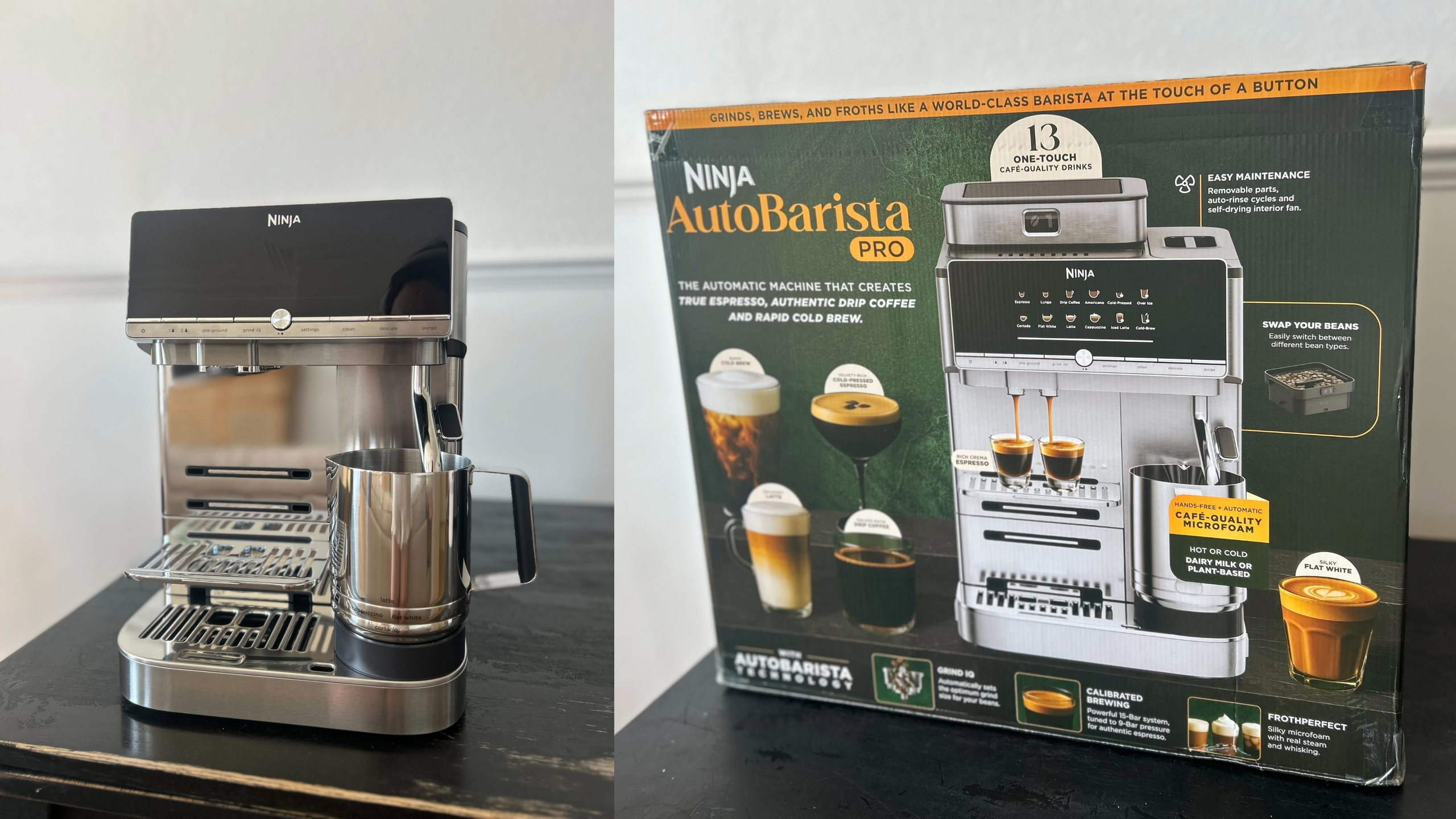
Ninja’s expansion of its coffee machines has reached new frontiers with the AutoBarista Pro, the brand’s first try at an automatic bean-to-cup coffee machine.
I’ve tried both of the Ninja bean-to-cup machines released in the series so far, the Luxe Café and its Pro series upgrade. I think both of these deserve the title of one of the best coffee machines you can buy, especially in terms of value compared to brands like Sage. So my hopes were very high with this automatic version. Here’s how I got on with it.
In a nutshell
I’ve reviewed a fair few automatic bean-to-cup machines now, but none quite like the AutoBarista Pro. That’s because in both looks and operation it reminds me more of its Ninja Luxe Café sister machine than anything else, especially thanks to its milk frother, which uses the same jug mechanism.
The kicker though? At £900, this machine is almost double the price that you can often find the Luxe Café on sale for and though it’s undoubtedly impressive, I’m not entirely sure its worth the price jump.
Things that did impress me were the Auto IQ program, as well as the colour screen and icons which definitely added a premium feel to the machine. After getting through the calibration process, which admittedly took a hot minute, the taste of the coffee was great.
It’s just personal prefer but I would pick the milk jug design that features here over fiddly plastic-y tubes that you usually get with auto bean-to-cups. But it does mean it’s a more involved coffee than with something like the De’Longhi Eletta Ultra, for example, as you have to pour over your own milk. A small thing, but different to just pressing one button and letting the machine to the rest.
The swappable bean hoppers will be a huge pull for those who like a decaf in the afternoon, hugely cutting down on fuss, and the advanced cleaning features will also please many making the switch from their espresso machine to this. As with the Luxe Café, the small drip tray that fills very quickly is pretty annoying.
Who tested this coffee machine?
Unboxing the product
Product specs
- Machine type: automatic bean-to-cup
- Water tank capacity: 2.37 litres
- Pressure: 15 bar pump pressure
- Dimensions: H40.2 cm x W27.1 cm x D45.2cm
- Colourways: Black & Stainless Steel/Midnight Blue/Oat Milk/Vista Green/Bronze
- Included in the box: milk jug, 2 x 340g swappable bean hoppers, cleaning kit, water hardness test strip
- RRP: £899.99
This is a big hunk of a machine. It’s 18cm deeper, 5cm wider and 13.2cm heavier than the Luxe Café, which is by no means small. It’s stretches out in every dimension and will requite either a deep worktop without overhanging shelves or a dedicated coffee station. I had to test it on my dining table in my house, as I’m without either.
It’s also very heavy, weighing 22kg. Set-up (or even just getting it off the doorstep) is not for the faint hearted so rope in reinforcements to get it in situ. As with all Ninja products it’s wrapped up well in cardboard and other recyclable materials with a very smooth set-up process helped by a QR code sticker on the front of the machine.
I think the machine looks quite expensive overall but it’s generally not as appealing as something like the Sage Barista Touch Impress which is fairly similar in terms of ability. The feedback reader, where you get instructed when grinding, is less of an interface and more of a rolling message banner. It doesn’t feel premium compared to the kind of interface you get with a De’Longhi or similar, where the colour screens are very immersive.
The milk frothing wand is very wide, miles different from one you’d find on a standard espresso machine. The jug is large too, which is good for adding milk to more than one coffee at once.
You control the screen via a dial and buttons that correspond to the icons on screen. The buttons, like the rest of the screen, are stainless steel and a magnet for fingerprint marks. If I was buying this machine the stainless steel/black colour combo would be at the bottom of my list – the Vista Green or Oat White get my vote instead.
First impressions
The materials you get with the machine make setting up easy – even if this is your first coffee machine. The big hurdle to get over with set-up is calibrating the Grind IQ program, which uses quite a lot of beans and is pretty loud.
During this process the machine will grind your beans, weigh out a dose and tamp it before pulling your espresso shot. It will do this several times until it reaches what Ninja say is the optimum grind. Then you’ll need to empty the grounds container, drip tray and refill the water as well as discard those starter shots.
From there, getting a coffee is straightforward (unless you want to change your beans, of course). The other big technical hitch to get over is swapping out the bean hoppers if you’re so inclined for a decaf afternoon coffee or simply an alternative blend.
There’s a simple locking system where you input the beans that works well when swapping over though the internal grinder will still hold some of the older beans so you’ll have to use the ‘purge’ button in that scenario.
The ‘Morning Rush’ test
In accordance with how we test coffee machines, the Morning Rush test sees us make several coffees back to back to see how the machine fares. As this is an automatic, I found it a pleasingly easy process. The machine turns on relatively quickly but will only give you your coffee if the drip tray is empty enough. Otherwise the screen won’t light up and allow you to progress.
But once you’re set up, it’s no issue to churn out a few black coffees in a row without complication. The machine has a thermoblock system which works well to keep the temperature consistent across multiple drinks.
The large jug means you can steam enough milk for two lattes at once or for 3 macchiatos if you’re only looking for a splash of milk. So if there’s four of you in your household and you all want a coffee before you head out for the day, many drinks in a row won’t pose an issue.
User experience
This machine isn’t marketed as a ‘one-touch’ convenience station as so many bean-to-cup offerings are, which is refreshing, as it is more involved than alternatives that integrate milk tanks into their main body.
Day-to-day when using this machine, you’ll probably notice that it takes a minute to wake up and flush out – this is all part of the machine’s automatic cleaning system. If something is awry (not enough water, grounds container too full) the machine won’t let you make a coffee until you remedy it which is good for preventing build-up.
When making a latte, for example, you’d touch to turn on the machine and wait for it to finish its warm up processes. You’d then select latte from the light-up menu and pop your cup under the spout as well as load your milk in the jug for the frother.
There are three adjustable levels you can pop your cup on and there’s plenty of space even for a carafe full of coffee if you fancy. You’d struggle to find a travel cup that wouldn’t fit under there which is a bonus.
The coffee dispenses first from the left. Once that’s stopped, the queued milk frothing process will begin automatically (with no need for you to prompt). The milk frothing is nice and quiet and relatively speedy too. All that’s left to do after that is pour over your milk (practicing your best latte art skills).
The milk wand on the AutoBarista is a step up from the one I’ve used previously on the Pro series version of the Ninja Luxe Café. Called the FrothPerfect, it whisks and steams at the same time automatically. The five milk settings include extra-thick froth and cold foam which is great for having a variation of drinks available.
Once you’re done with the milk jug, you push the wand back into place where it’ll auto-purge.
Noise test
As I mentioned earlier, this is a pretty quiet machine. Both the dispensing of espresso and the frothing of milk measure at about 60dB in my home, which is a plus for those who value discreet appliances.
What’s it like to clean?
The standard colour way for this machine is stainless steel. It’s not my favourite as it marks so quickly but it’s all down to personal preference. For me, any of the colours are much more appealing.
This machine inherits the same problem as the Ninja Luxe Café; the drip tray seems to need emptying at every turn. This is probably a good thing, as it’s due to the auto cleaning systems doing their job, but it can feel annoying.
The big pro for cleaning with this machine is the removable brew group, which is accessible via a side door. All you need to do to maintain it is pull it out and rinse it on a semi-regular basis.
How does it compare to competitors?
This machine is so unique that its hard to find a direct comparison. The De’Longhi Rivelia is currently our top-rated bean-to-cup model and at around £699, it’s quite a bit cheaper than the AutoBarista. Its compact size and sleek finish mean its likely more aesthetically friendly to most kitchens too.
Should you buy the Ninja AutoBarista Pro?
Ninja’s easy-to-use charm extends to this clever automatic machine. It makes great coffee, is easy to use and has plenty of features built-in to make owning a bean-to-cup machine more manageable. It’s not the prettiest option out there, though the colour ways make it slightly more bearable, and there are highlights that real coffee lovers wil rejoice at (the interchangeable bean hoppers and the assisted grinding).
For me it doesn’t quite live up to the greatness of the Ninja Luxe Café and its Pro version successor, but it’s a solid choice if you know you want a Ninja coffee machine that can pour a coffee without you needing to grind the beans yourself.
Read the full article here


