




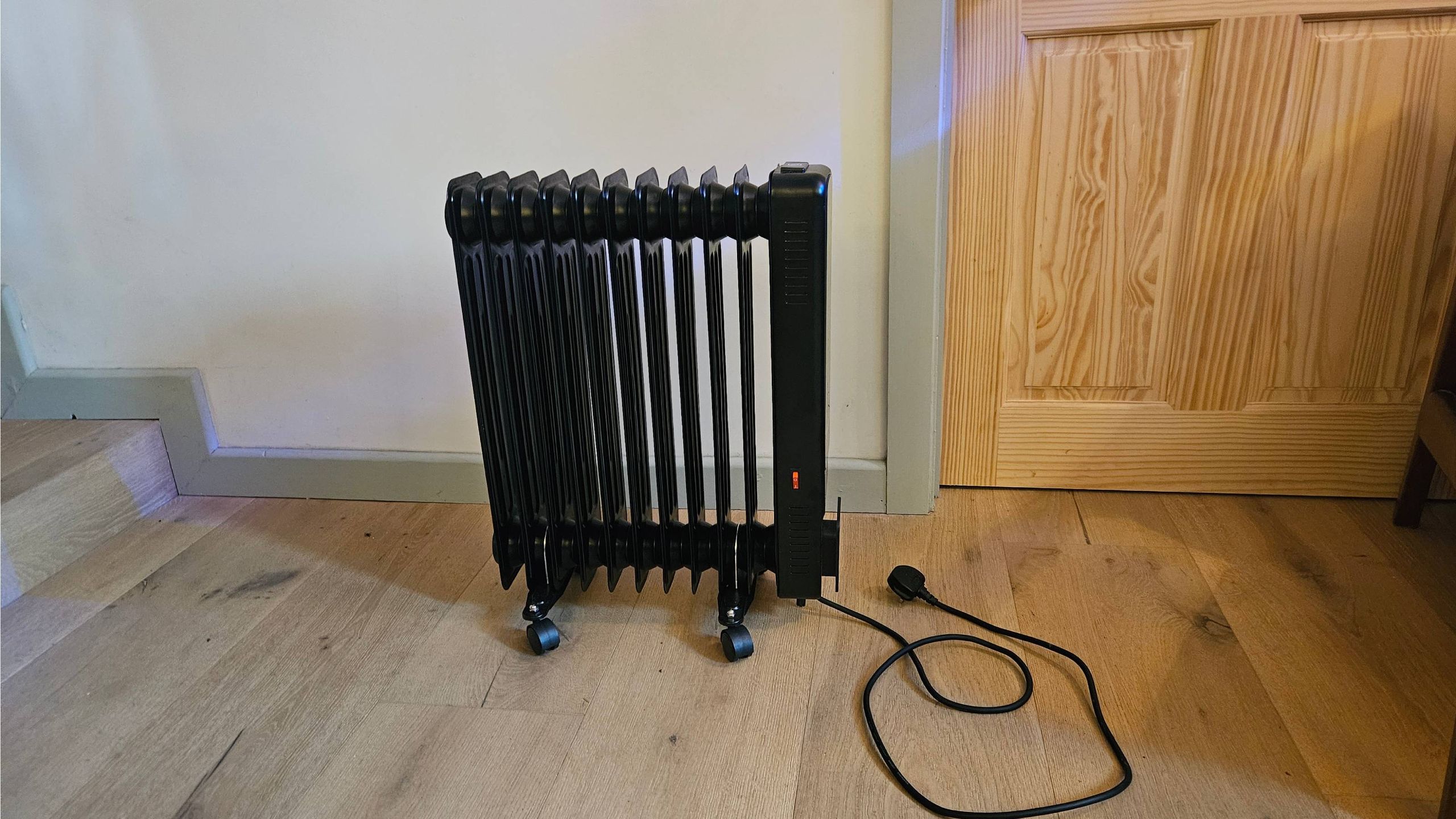
As the weather is becoming more mild, but still not particularly warm, turning the heating on for the whole house while I work from home is a waste.
So now is the ideal time for me to test out the Daewoo 2500W Oil Filled Heater with LED Display & Remote Control to see how it heats a room, what it costs to do so and how it compares to the best oil-filled radiators.
In a nutshell
I had previously only used an electric fan heater to generate an extra bit of heat when needed, so I was intrigued to try out an oil-filled radiator that works in quite a different way. While electric heaters tend to heat up quickly and cool down as soon as they turn off, oil-filled radiators take longer to heat up, but can continue giving out heat long after they are switched off.
I definitely had to be patient to wait for the Daewoo radiator to heat up, rather than using it for an instant burst of heat, but I was impressed that it was still giving out heat for a good couple of hours after I had turned it off.
It did struggle to heat my large open plan living room, so I think this would be better suited to medium-sized rooms around 25m2.
Specification
- Type of heater: Oil-filled radiator
- RRP: £89.99
- Weight: 9.2kg
- Dimensions (W x H x D): 45.5 x 59.5 x 24cm
- Wattage: 2500W
- Running costs per hour (based on January 2026 energy price cap): 55p
- Room size suitability: 25-35m2
- Smart features: None
- Dual functionality: None
- Oscillation: None
Unboxing, setting up and first impressions
The Daewoo oil-filled radiator arrived in a protective delivery cardboard box and then the branded packaging box. The radiator itself weighs less than 10kg, so it was simple enough to move into position.
Getting the radiator out of the box was a bit tricky thanks to the double cardboard, so I found it best to lie the box flat, cut the tape on one end and slide the radiator out, rather than trying to lift it out by the top. I loved that the packaging was almost entirely recyclable, with the plug, casters and wheel plates in cardboard boxes and the radiator itself secured by moulded cardboard ends. Even the protective bag for the radiator was made out of recycled materials and is able to be recycled with soft plastics at a supermarket.
Before turning it on, I had to attach the caster wheels which didn’t take long, but it meant turning the radiator upside down and while I was able to do this myself, some might find it difficult without a second pair of hands. I did also feel a bit uneasy when I could hear the oil trickle down! But fortunately the oil is fully contained so there’s no chance of it escaping.
The instructions advise to use a spanner to tighten the domed nuts, (although this isn’t supplied), but the rest can be done by hand. Once assembled, I turned the radiator right side up and found the manoeuvrability of the castors was slightly sticky. The radiator definitely prefers to move directly forward with side or diagonal movements resisted by the castors. They loosened up after a couple of journeys ferrying between rooms, but I’m glad that my bedroom and living room are on the same level, otherwise this would have been a bit tricky.
After plugging in, you have to use the red switch on the side to give the radiator power and then also press the power button on the touch LED display. It also comes with a remote that I found easy to use (although I had to hunt around for some AAA batteries as they weren’t included).
The radiator automatically starts at 35ºC on comfort (full power) mode, but the temperature can be decreased using the touch screen or remote. Tapping the cog/settings icon will toggle through comfort, eco and anti-frost modes. A nice feature is the light dimmer, which you can have on full, slightly dimmed or off.
I like that the radiator has a useful timer function to turn it on and off — don’t do what I did though and cycle through them too quickly. If you press the timer by accident, which I did, you have to cycle through 24 hours to cancel it.
What’s it like to use?
It’s important to understand the differences between oil-filled radiators and electric heaters, with one main point of difference that oil-filled radiators are known for heating up slowly (more slowly than electric heaters), but holding on to their heat for longer once switched off. And I definitely found that to be true for this Daewoo model.
First up, I tried it in our open plan living room (which is admittedly a pretty large space — approximately 38m2) but I think this was a little too large for this oil-filled radiator (which states it’s suitable for large rooms up to 35m2) to handle. The room started at 16.9ºC and two hours later it just about hit 17.9ºC. That just goes to show how important it is to use the right size heater for the space you want to heat.
Next, I tried it in my much more suitably-sized 17m2 bedroom with better results. The 14.3ºC room heated to 17.5ºC within an hour.
I can also attest to the fact that the radiator holds on to the head long after being turned off. I went to move it about 15 minutes after I had turned it off, and it was still giving off heat. In fact it was giving off residual heat for a good two hours after it has been turned off. While this free heat is definitely a plus, it did mean it was a little difficult to move from where I’d had it placed centrally in the room as the handle was hot to the touch for a long time after turning it off.
I also liked that the noise levels were pleasingly low at just 28dB, even when the radiator was on its highest setting. I definitely prefer this to fan heaters that can give off a significant whirring sound that I find a bit distracting.
Running costs
This Daewoo radiator has a wattage of 2500W, which means that per hour, it costs 55p on comfort mode based on the January 2026 energy price cap of 27.96p/kWh.
Eco mode drops the use down to 1000W so will continue to keep the radiator warm at a steady temperature. This mode will cost just under 28p an hour to use.
At the time of writing, oil prices are surging due to ongoing world events and burning oil at 137p/litre (compared with 62p/litre 12 days prior) for our oil boiler heating seems like madness. So I’m happy I have this little heater to keep warm instead of putting the central heating on.
Cleaning and maintenance
A little dust is all this oil-filled radiator needed to stay in working order. Before cleaning, I made sure the radiator was completely cool and unplugged from the mains power. The instruction guide warns against use of any abrasive cleaners and to simply wipe down with a damp cloth.
I would suggest a microfibre cloth in order to get between the fins for a thorough clean, or a microfibre or feather duster for removing dust.
Who should buy this oil-filled heater?
The Daewoo 2.5kW oil-filled radiator is best suited to rooms you are going to inhabit all day, so I think it would be ideal in a home office or small living room where you can have it nearby to feel the benefits of the warmth, even when it’s turned off.
Depending on how small the room is that you want to heat, you may get away with a lower powered model, like the De’Longhi TRNS0505M 500W Oil Filled Radiator, and benefit from lower running costs.
However, if you are after a quicker burst of heat, then you may be better off with an electric heater, such as the Morphy Richards HeatFlux Ultra Thin 2kW ceramic tower fan heater, that heats up much faster than an oil-filled radiator. Although the pay off for a quick heat up time is that it doesn’t retain heat for long after it’s been switched off.
Read the full article here