







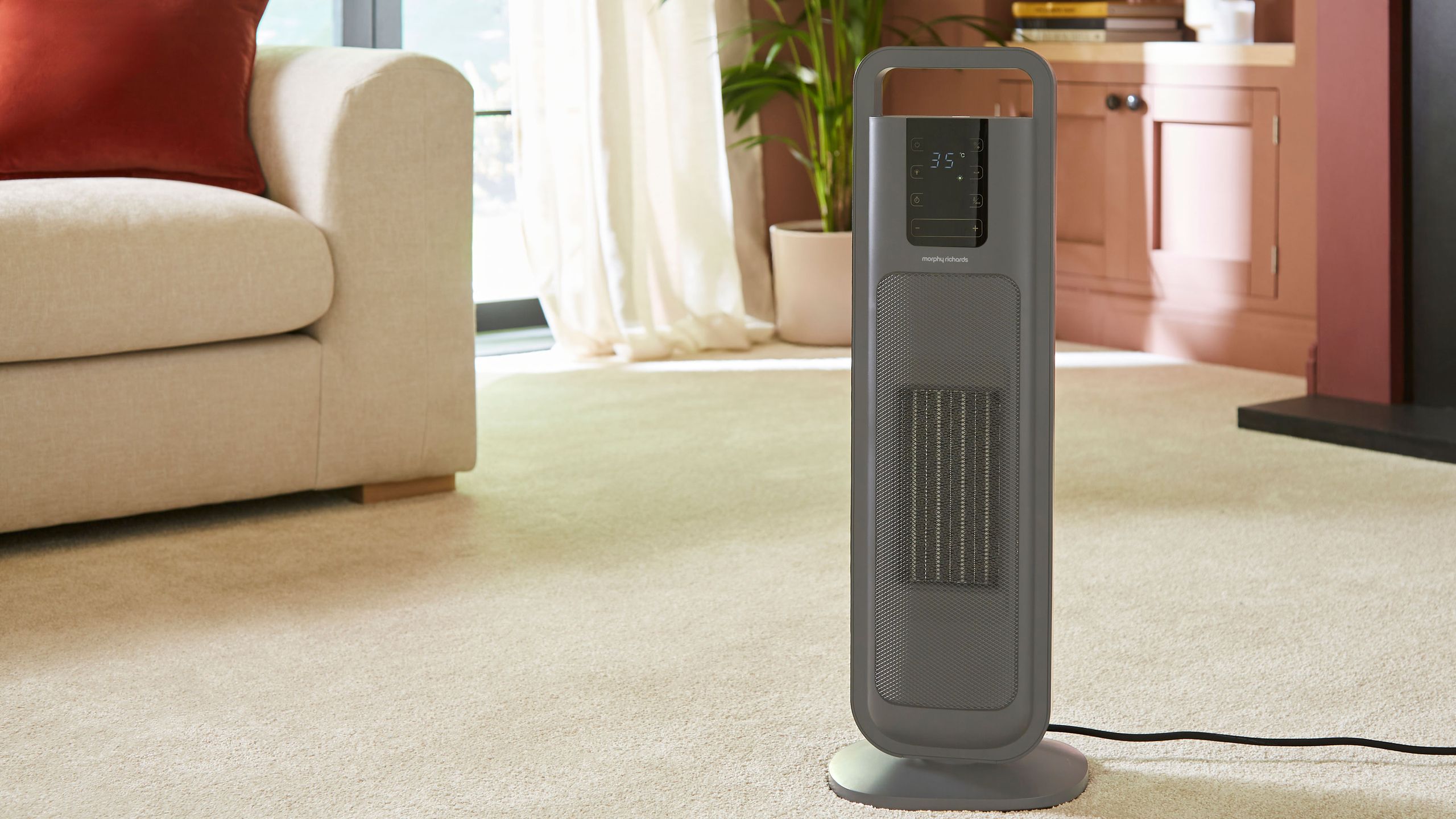
In the past, electric fan heaters suffered a bit of a bad rep, often being viewed as unattractive, bulky energy guzzlers that were only really any good for creating little hot spots and posing something of a fire hazard to boot.
The days of course things have moved on and the best electric heaters are now seen as a really useful method of heating up a room fast – plus they come with all kinds of nifty features that mean they don’t have to result in eye-watering energy bills.
That said, not all are created equal. As a someone who works from a very cold house, and who regularly suffers numb fingers and toes, I couldn’t wait to test out this offering from Morphy Richards and I definitely wasn’t disappointed – this is nothing like the fan heaters of old and really has transformed my working days.
In a nutshell
Smart, slimline and simple to use, this lightweight tower fan heater blended into my home seamlessly, unlike my old clunky white model which I would shuffle out of sight when guests came around.
It can be controlled via the touch-screen control panel or by a nifty little remote, both of which are pleasingly sparse in terms of buttons. That said, don’t let the lack of knobs and dials fool you into thinking this fan is short on attributes – it really isn’t. While it might not have any smart features, it offers a timer function which is really easy to get to grips with, an eco mode that helps you avoid wasting heat and energy and three heat settings.
The fact that it can be set to oscillate was a huge bonus for me and would be for anyone wanting a good, even distribution of heat, say, in an open plan space like the one I was testing it in .
How I tested the fan
Specification
- Type of heater: Fan heater
- RRP: £100
- Weight: 2.8kg
- Dimensions: (W x H x D): 18.7cm x 65.8cm x 23.3cm
- Wattage: 2kW
- Running costs per hour: £0.55 – £0.56p/kWh
- Room size suitability: 20m2
- Smart features? N/A
- Dual functionality? None
- Oscillation? Yes
Unboxing, setting up and first impressions
The Morphy Richards HEATFLUX came really nicely packaged and I was pleasantly surprised when I took it off the doorstep at how lightweight it was to bring inside, even while still in its box.
On opening up the box it was not only a huge relief to see that there were minimum components to get to grips with, but also that the packaging itself had been kept to a minimum. No polystyrene, three cardboard support pieces, two slim cardboard boxes housing the plug and base and just two plastic bags. The cardboard will actually come in handy as firelighters.
On removing the fan from the box I was struck again by how lightweight it is – plus, it has a carry handle at the top. It is a nice mid-grey shade that will blend in easily with all kinds of room decor and it’s super slimline too.
In terms of set-up, all that was required was for me to click the tower section onto the base. I have to say, to begin with my brain didn’t quite register how to do this and there weren’t any guidelines in the user manual that had come in the box. However, after fiddling around for a couple of minutes, I realised that I was trying to put the base on upside-down – after this it clicked on really smoothly and I was good to go.
What’s it like to use?
I am going to start with a little scene setting here. My house is old and very cold – pretty much year-round, but I am testing this fan heater in February meaning it is particularly chilly right now. When I come downstairs in the morning the thermostat tends to read around 16°C in the open plan kitchen/diner/snug I sit at my laptop in.
To get going, you simply plug the fan in and use the switch located on the back to turn the unit on – after which the fan will enter standby mode. The fan can then be controlled using either the smart touch screen control panel on the front of the unit, or via the little remote control, which came fitted with the battery, ready to use. Both are pretty much self-explanatory thanks to the clear symbols but the user manual is also easy to follow.
Along with the on/off switch, there are controls for the timer, temperature, control panel lights (handy if you want the display to go dark at nighttime) and swing function.
When you turn the the fan on using the standby on/off switch, it starts at the default temperature of 35°C and at low power. You can then change the temperature and the power setting. There are three power settings to choose from – ‘low’, ‘high’ and ‘cooling’. I started using the high setting but soon found that ‘low’ worked just fine, even in my open plan space.
In terms of noise levels, the fan runs at 45dB. Once it is up and running, the fan gives off what I would call a gentle-to-mid level hum, perhaps just a notch higher than that given off by a fan oven when it is on, but lower than a dehumidifier.
It heats up within minutes. I decided to place it in the snug area of the open plan space, in a position I felt would give the most even distribution of heat. I then set it to oscillate – and if you have an open plan space I would highly recommend this as it made such a difference in a very short space of time. Personally I would have preferred the cable length to be a little more generous in order to get even of a more central position within the room.
Something I really like – as did my husband, who is very much a ‘just put another layer on’ type of person in the face of a cold house – is the ECO mode. When you select this the heater will automatically adjust the heating power based on the room’s temperature – if the temperature sits between 18 – 25°C it runs at low power, if it rises above 25°C all functions go off, and when the temperature is less than 18°c the fan runs at high power. Simple.
As we have pets and two ever-so-slightly clumsy teenagers, one of whom likes to chuck his rugby ball about indoors, I was a bit worried that the tower design might prove a little unstable. However, the base has a good weight to it and should it tip over, it automatically shuts off.
Finally, there is also a ‘cooling mode’ – obviously right now I don’t need this but it is designed to keep the room temperature at 7°C which could be useful in the summer months. I could only get this to work using the control panel, not with the remote.
Running costs
Just like any kind of electrical appliance, the running costs of this fan depend on the power setting you use, the length of time you use it and your electricity costs.
Based on the January 2026 energy price cap figure of 27.69p per kilowatt hour, this means that to run the fan for one hour at high power costs roughly 55p. Turn it to low power or ECO and you could be looking at running costs as low as 36p per hour.
While this doesn’t sound like much, if you were running it all day long, every day, in addition to your central heating, costs could soon add up so it is best reserved for a quick blast of heat first thing in the morning. The timer function is really useful here too. I could set it to come on for an hour before getting up in the morning and come down to a nice warm kitchen.
Cleaning and maintenance
The mid-grey matte finish of the fan means it shows up dirt far less easily than my old white fan heater. A quick wipe over with a dry cloth removes any dust from the front grille although I wonder if, over time, dust could build up in this grille – in which case a quick once-over with the vacuum nozzle would probably do the trick.
Removing the filter from the rear is easy. Just click it off. It isn’t a soft filter like you might expect to find in a vacuum, so washing and drying it is a quick, simple affair.
What do other online reviews say?
The reviews for this tower heater are, in the main, really positive. Like me, users seem to love the slimline design and how lightweight it is, as well as appreciating its unobtrusive appearance. Before this fan, I had a smaller white one that really did nothing for the decor in my home, but you wouldn’t really notice the Morphy Richards model tucked into a corner, oscillating away.
There were a few negative reviews, of course, and I did agree with a couple of these. One was cord length – like me, some found it could do with being longer and I wouldn’t want to be pulling out extension leads in order to get it sitting more centrally.
A few reviewers felt that the heat it produced wasn’t well distributed but I can honestly say I didn’t find this to be the case – quite the opposite in fact.
Who should buy this electric heater?
If, like me, you work from home, or live in a chilly old house that could benefit from a burst of heat to take the edge off periodically, I don’t think you can go far wrong with the Morphy Richards HEATFLUX Ultra Thin 2kW Ceramic Tower Fan Heater.
Yes it is more expensive than some other models on the market, but what you get for that extra initial output is something that looks stylish and smart and offers settings that can save you from wasting energy.
Even in my open plan space I felt a really welcome and noticeable difference when using this and, when I closed the doors leading off to other rooms, the heat felt like it stayed in too.
Being a fan heater though, it doesn’t retain heat once turned off in the same way as your radiators might. If you want something portable that does, you would be better off looking at some of the best oil-filled radiators out there such as the VonHaus Oil Filled Radiatoror, if you like the idea of a portable heater with some smart features that lets you control it when you are not at home, the Dreo Smart 9 Fins Oil Filled Radiator is a brilliant choice.
Read the full article here


